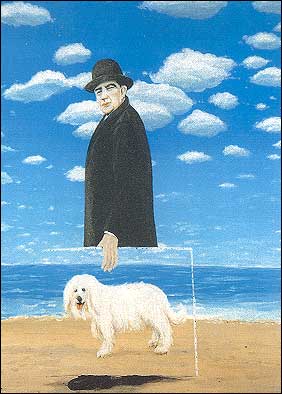
Magritte im Himmel und Pommery auf Erden
This is not a Magritte,* but by
Fred E. Knecht
Magritte im Himmel und Pommery auf Erden This is not a Magritte,* but by Fred E. Knecht | |
| \/ |
The real world |
| Two weeks ago I heard a lecture at the University of Vienna in which the lecturer talked about perceptions and illusions. Onto the viewing screen, he projected the american flag in dark green, black and yellow colours. When he took it off, as expected, all of us saw the image of the red, white and blue american flag. We all saw the colours red, white and blue, even though they were never there! The lecturer claimed that this is a very peculiar property of the human mind, to see things that are not there. | |
| Actually, that is what we have been trained since childhood: to see and to produce things that are not really there. It begins with stories we are told, about realities that do not exist in the present, or that have never existed. These stories are often meant to influence our behaviour or beliefs about the world. These stories, although "known" by a vast number of people, are unreal. Our young minds perceived them as real, or at least possibly real, yet they are not. | |
| I remember countless moments in my life of being taught not to trust my senses. Here are a few examples: | |
| (1) My mother was studying economics. When I was beginning to know about money, I had several questions about money, and why people invest in markets, and what it is supposed to mean for money to increase itself, and why she kept telling me that the world can only "develop" due to the flow of money. My questions began at about the time I was in preschool. Having been raised (at school) in the mentality of doing things for each other out of free will and out of a consciousness of the whole, or of the greater good, I knew that the best things created did not depend on money. My questions about it continued throughout my life; my logical reasoning was disregarded. Now years later, the economic bubble is bursting, and I am vindicated. | |
| (2) That medical treatments are supposed to cause a little bit of discomfort, so that we can avoid getting sick, or even get better if we are sick. Although I fell for this one hook, line and sinker, or rather, because I fell for it, I am now discovering the backlash of treatments that I allowed to be carried out on me that I did not really want. Further education and reading teach me of long and short term effects of treatments as simple as immunization and tooth fillings. | |
| So we are taught to believe in fun things like Santa Claus, or serious things like Economics, Religion and Medicine, based on stories, whose true origins we can neither know nor experience for ourselves. In the last twenty or so years, we have increasingly become a part of that false reality: We live with money we do not have (for those of us who have taken out loans); we submit to authority we cannot trust; and rather than sew a dress or knit a scarf or build a violin or a table, we spend our time at computers, creating a virtual reality that has no real existence and can be deleted or reconfigured at the blink of an eyelid. | |
| I have more reasons than most people to miss the past, or "not to get over" the past. But I think no matter what happens, I will never give up my attachment to a real world in which we interact with real materials and beings rather than virtual ones. | |
| /\ |
H 10/08 |
| * 'Ceci n'est pas une pipe' ('This is not a pipe') is one of the most famous paintings by René Magritte (1929). Pommery was Fred Knecht's dog. |